Ayodhya with Elderly Parents: A Complete 2026 Guide
If you are reading this, the trip is probably your idea and not theirs. Your father mentions Ram Lalla every time the news shows the temple; your mother says she is too old to travel now. You are the one who has to work out whether it is actually doable, and what happens if it goes wrong.
It is doable. Ayodhya in 2026 is genuinely kinder to elderly pilgrims than it was even two years ago — and the two things that decide whether the trip works are the walk and the heat, both of which can be planned around.
The change that matters most (August 2026)
The Shri Ram Janmabhoomi Teerth Kshetra Trust simplified darshan for elders this year, and most guides online have not caught up:
- 1 Pilgrims aged 70 and above no longer need any prior approval for the Sugam Darshan pass. Show an Aadhaar card and the pass is issued directly at the counter — no online application, no approval wait.
- 2 The separate pass for Ram Darbar is gone. After Ram Lalla darshan in the normal queue, pilgrims move on to the first-floor Ram Darbar in the same visit.
For your parents that means one queue instead of two, and less paperwork on the morning that matters. Carry the original Aadhaar for each elder — it is the document that unlocks the easier route. Full process in our Sugam Darshan pass guide.
What the temple complex gives you
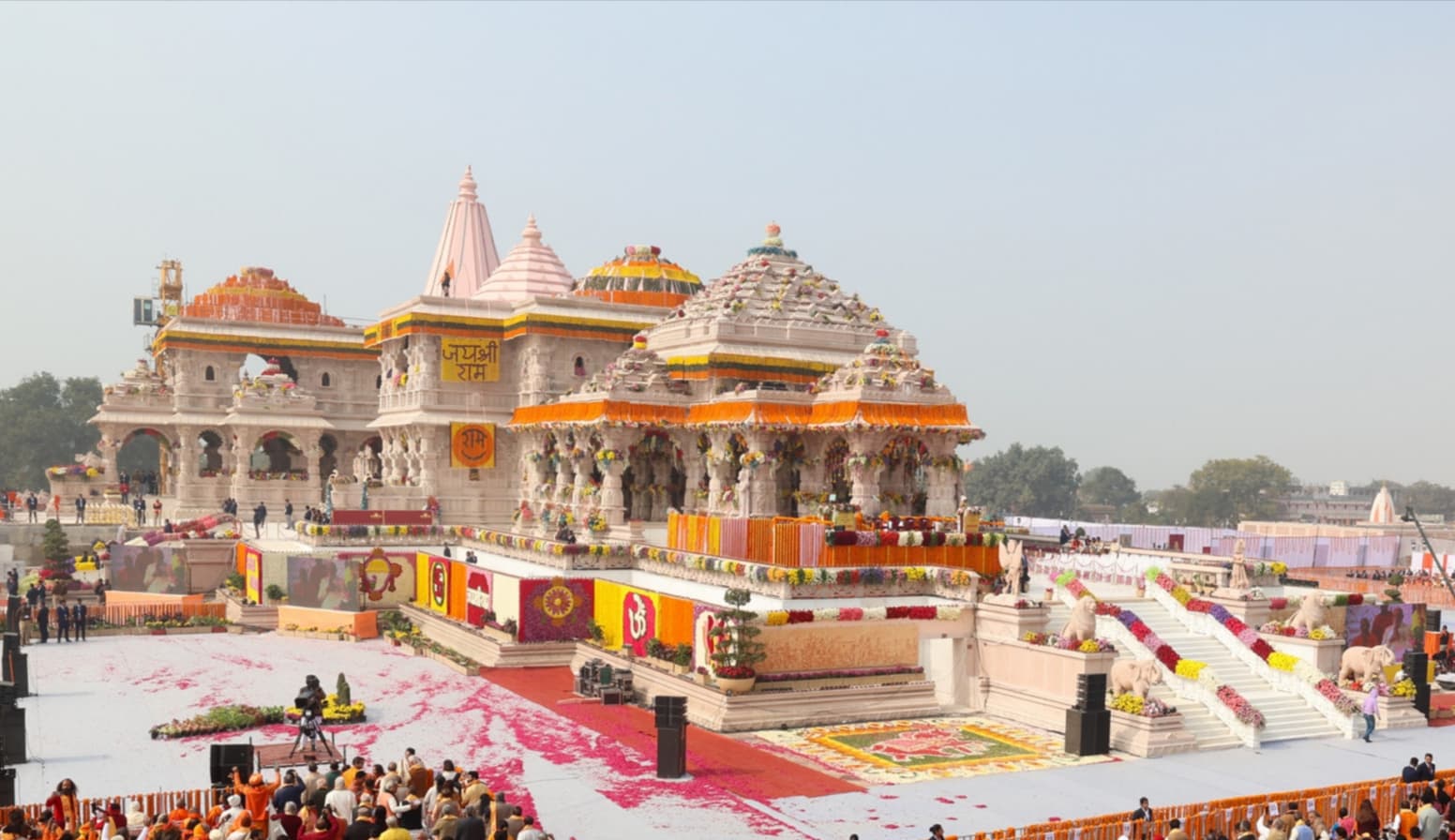
The Ram Janmabhoomi complex was built with accessibility in mind. As it works on an ordinary day:
- Wheelchairs with attendants, free of charge, at the facilitation areas near the main security entry — availability is good on normal days, stretched on festival days.
- Electric carts run between the outer drop points and the temple security gate for elderly and differently-abled pilgrims, so nobody has to cover that stretch on foot. Ask at the assistance desk; carry ID.
- Ramps and grab rails on the temple approach, and a darshan route that avoids stairs for those who need it.
- Resting areas and first-aid assistance at the facilitation centres, along with drinking water.
The walk is the enemy, not the temple. Get the cart and the wheelchair sorted, and a 78-year-old can do darshan without the day turning into an ordeal.
One honest caveat: these facilities are run by the Trust and the district administration, and their capacity flexes with the crowd. On Deepotsav and Ram Navami weeks the picture is different from a quiet Tuesday in February. What we do for our clients is reach the complex early, get the cart or wheelchair arranged before the rush builds, and keep one family adult with the parents at every minute.
The honest limits, said plainly
Hanuman Garhi has around 76 steep steps and no ramp. Elderly pilgrims have two options: a doli (palanquin) — agree the rate before boarding, it is typically a few hundred rupees — or darshan from the lower courtyard. The tradition is Hanuman leading you to Ram, and that blessing does not require the summit.
Queues still exist. Even the assisted route moves in a queue, and on festival weeks it can take hours. There is no honest operator who can promise you a queue-free darshan; anyone who does is selling something that does not exist.
Summers are brutal. From April to June the plains run 38–44°C. If your parents are visiting in those months, darshan happens at first light and the afternoon is for resting, without exception.
Vehicle drop points are far. Cars cannot approach the temple; the final approach is roughly 1.5–2 km of walking without a cart. This single fact is why some elderly visitors end up seeing the temple through a car window and going home half-fulfilled. It is also the easiest problem to solve in advance.
The plan that works for parents
The rhythm is simple: one temple per half-day, the car waiting at every stop, and nothing scheduled between one and four in the afternoon.
| Day | Morning | Afternoon | Evening |
|---|---|---|---|
| Day 1 | Arrive, hotel, rest | Light lunch, settle in | Ram Ki Paidi — flat promenade, sit for the Saryu Aarti |
| Day 2 | Early Sugam darshan (70+ Aadhaar route), breakfast after | Full rest | Second visit to the ghats, or the hotel |
| Day 3 | Kanak Bhawan (wide, shallow steps, with a supporter) or Nageshwarnath (flat) | Lunch | Depart |
Two nights covers darshan properly. Add a third night if you also want Guptar Ghat or a second, quiet darshan — it costs less than the stress of a rushed departure.
Hotel checklist for parents
Four questions decide whether the room is right, and none of them is about stars:
- 1 Lift or ground floor? A third-floor room with no lift is a non-starter for knees and hearts.
- 2 Western toilet with a walk-in shower? Squat toilets and high tub walls are a genuine fall risk.
- 3 Hot water around the clock, or fixed hours? This is the single most common complaint in Ayodhya reviews.
- 4 How many walking minutes to the temple, honestly? Ask for minutes, not kilometres. See our where to stay guide for the area-by-area trade-off.
Before you travel: the practical list
- Aadhaar card for every pilgrim aged 70+ — it is the pass.
- Medications in original strips, plus a photo of the prescription on your phone.
- Schedule around sugar and BP. Darshan after breakfast but before the heat; never on an empty stomach.
- Emergency numbers saved: 112 (all-India emergency), 108 (ambulance).
- Footwear: slip-on shoes and socks. You will remove shoes more than once, and the stone can be hot.
- Wheelchair requests in advance if constant support is needed — festival weeks exhaust the standby stock by mid-morning.
What our senior yatra actually does — and does not do
Our Senior Citizen Special Care Yatra is a 3-day package built only around what we genuinely control: the vehicle is positioned at the closest permitted point at every stop, a coordinator stays with your parents from arrival to departure, rooms are ground-floor or lift-served, afternoons are rest by design, and meal stops are timed around their medication.
What it does not do: skip security, magic away festival queues, or pretend a doctor travels with you. What we do about health is practical — medication-friendly scheduling, a first-aid kit in the car, and the nearest hospital and chemist mapped in your itinerary before you land.
If you would rather plan it yourself, everything above is enough. If you want your parents looked after while you handle the rest, message us on WhatsApp at +91 84008 08200 with their ages and any mobility needs, and we will tell you honestly what is smooth and what is not.
Where to go next
- Senior Citizen Special Care Yatra, 3 days from ₹5,999 — the slow-paced version of this guide, arranged end to end.
- Sugam Darshan pass guide — including the Aadhaar rule for 70+ pilgrims.
- Where to stay in Ayodhya — lift, hot water and walking minutes, area by area.
- Best time to visit Ayodhya — the months that are kind to elders.
Planning this trip and want someone local to handle it? Our office is on NH 28, Deokali Bypass, opposite Hotel Panchsheel, Ayodhya Dham. Message the desk on WhatsApp at +91 84008 08200 and we will put together an itinerary for your dates.
Planning this trip?
Talk to our Ayodhya desk before you book anything.
We are a local Ayodhya agency — hotels, darshan passes, AC cabs and guides arranged by the same team that meets you at the airport. Rated 4.9 on Google by pilgrims who travelled with us.
Written by the Go Ayodhya desk
A local team on Deokali Bypass, Ayodhya — we run the ground ourselves, not through sub-contractors. Anything in this guide we can also arrange for your dates: about us or talk to us.